
Beyond The Balance Podcast
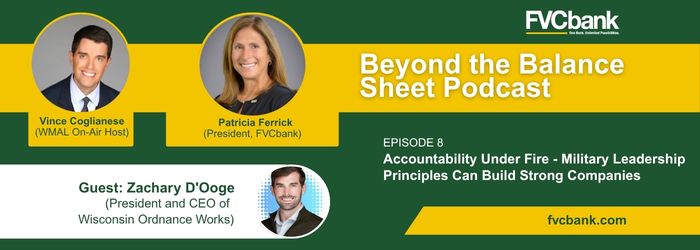
Episode 8 | Accountability Under Fire – Military Leadership Principles Can Build Strong Companies
Overview
In this episode of Beyond the Balance Sheet, hosts Vince Coglianese and Patricia Ferrick, President of FVCbank, sit down with Zach D’Ooge, President and CEO of Wisconsin Ordnance Works, to explore how military leadership principles translate into building a strong company. A West Point graduate and former Army officer, Zach traces the through-line from the battlefield to the shop floor: accountability and ownership when there’s no one left to ask, the reality that no plan survives first contact, and the servant-leadership approach he uses to build teams capable of operating independently under pressure. He also makes the case for domestic defense manufacturing — Wisconsin Ordnance Works produces the precision drivetrain systems that keep Abrams tanks, Bradleys, and recovery vehicles moving — and explains why a supply chain that can be switched off from overseas is a risk the country cannot carry.
As we celebrate America’s 250th anniversary, the conversation draws a parallel between the courage it took to found a nation and the courage it takes to build a business: both begin with a hard decision and depend on people willing to stay in the arena. Zach challenges the idea that entrepreneurship requires a flashy startup, arguing that the unglamorous, essential work — machining, manufacturing, precision at scale — demands the same ownership and controlled risk-taking the military forges in its leaders. If you lead a team, run a company, or are weighing a leap of your own, this conversation offers a practical framework for accountability, resilience and taking the risk that comfort would talk you out of.
Prefer reading over listening? You can read the full transcript of the episode below.
Welcome, America 250, and Zach D’Ooge
Vince Coglianese (0:03): Welcome to Beyond the Balance Sheet, the podcast where we explore the leaders, innovators, and entrepreneurs who help shape the future of American business and community. I’m Vince Coglianese. With me, my co-host, Patricia Ferrick, the President of FVCbank. As the United States approaches its 250th anniversary, we’re taking time to reflect on the values that built this country, leadership, service, innovation, and the courage to take risks.
Patricia Ferrick (0:29): And at FVCbank, we’re proud to highlight those values through our America 250 13 Stars Initiative, recognizing the leadership principles that continue to guide businesses and communities today.
Vince Coglianese (0:42): Our guest today is Zach D’Ooge, a graduate of West Point, a former Army officer, and now the President and the CEO of Wisconsin Ordnance Works, a company that’s supporting American defense manufacturing. Zach, welcome to Beyond the Balance Sheet. Very glad to have you with us today.
Zachary D’Ooge (0:57): Thank you, Vince, and thank you, Trish. I appreciate it. I’ve never been on a podcast before. It’s very exciting to be here with you, both.
Vince Coglianese (1:04): We’re glad to do this with you for the first time. It’s awesome.
West Point Origins After 9/11
Vince Coglianese (1:05): Hey, Zach, your story really begins at one of America’s most historic leadership institutions. That’s West Point. Now, what inspired you to attend West Point and how did that experience help shape your path into military service?
Zachary D’Ooge (1:16): Yeah, I think it actually goes a lot earlier in life than that. I grew up in a military family, so I was born in Hawaii, I lived over in Germany, I moved constantly. I was just exposed to it my entire life. And I always knew I wanted to go be a part of it. It was very fascinating. You see the machinery, the equipment, the commitment of the people, everything all coming together. And um that came to a head in 2001 when I saw my cousin graduate the Air Force Academy. And it was just impressive seeing jets flying over, the grandeur, just this massive synchronization that came together. And it was frankly just really impressive. And I kind of put my finger down, and that’s what I wanted to go do at that point. Go through a military academy, go serve, and uh be a part of that.
Vince Coglianese (1:55): That’s amazing, 2001. So of course that’s 9-11 later that year. So you witnessed.
Zachary D’Ooge (2:00): It was in May.
Vince Coglianese (2:01): Yeah, May of 2001, and then September, of course, 2001 comes along. So you have this world where you’re like, I want to be in the military, and then you see the American military deploy almost immediately in September of that year. It must have been a wild year for you.
Zachary D’Ooge (2:11): It was a wild year. My dad was retiring that same year. It was uh yeah, it was a wild next couple of years afterwards.
Vince Coglianese (2:17): Wow. So you later then then of course you go to West Point, you become an army officer, where your leadership decisions will carry the enormous responsibility of people’s lives that are you’re responsible for. What did that experience teach you about leadership under pressure?
Battlefield Leadership For Business
Zachary D’Ooge (2:31): The first thing that comes to mind is accountability is very important and ownership. If you’re out on the battlefield, there’s more than often you have no one to go ask questions to. You just have to get the job done. You are on the ground. And secondly, no plan survives first contact. You need to be able to react to the unknown. You need to be able to get a culture with your soldiers and your team to do the same. I think oftentimes you think of the military as being this highly, tightly centralized control environment, but the the reality is you’re building teams to operate independently because there is a dark side of the battlefield. And I mean that in the context of you can’t just physically talk to each other and you have to trust the people to be accountable and to take ownership.
Patricia Ferrick (3:10): So to build on that, for listeners who may not have experienced military leadership environments, what are some principles from army leadership that business leaders could learn from?
Zachary D’Ooge (3:21): Yeah, I I touched on one of them. The accountability and ownership is the law I just want. I I think it’s very easy, and I witnessed this a lot in my MBA program that I think when folks are transitioning to management, they’re expected to have all the answers. They’re expected to give all the direct guidance and have it all figured out. And uh I learned through my experiences to take more of an iterative approach. I still implement a lot of the troop leading procedures, very structured formula processes that we use in operations planning when I think about doing a project, for example.
What Wisconsin Ordnance Works Builds
Patricia Ferrick (3:49): So, Zach, for listeners who may not be familiar with Wisconsin Ordnance Works, tell us about the company and the role it plays in supporting American defense.
Zachary D’Ooge (3:58): Well, first and foremost, I love the acronym. Wow. It’s just an exciting uh acronym for the company. Uh but more serious notes, the company’s been around since the 60s. We are a defense manufacturer. We are highly specialized in tracked vehicle drivetrain systems. So think about our Abrams battle tanks, our Bradley’s recovery vehicles. We’re on all of them. Some very easy parts to identify are the very front and the back wheels on those systems, carriers, sprockets, idler wheels, big parts that need to be manufactured to a very high level of precision.
Vince Coglianese (4:32): Yes. And be battlefield ready and be capable of being worked on in a battlefield.
Zachary D’Ooge (4:37): Correct. 100%.
Vince Coglianese (4:38): Yeah, and that’s a big deal. Um what kinds of capabilities or products does your company uh provide that support the defense sector in addition to this?
Zachary D’Ooge (4:47): Yeah, I touched on a few of them. Those are the major ones that we’ve got running around. Um but larger format machining. So ramp engines are running through, we’ve got lots of gear sectors, we’ve got parts going on nuclear submarines, we’ve got a few air parts right now, uh, mostly drive train systems for tracked military vehicles.
Keeping The Defense Supply Chain Home
Patricia Ferrick (5:03): Why is domestic manufacturing so important to the defense supply chain?
Zachary D’Ooge (5:08): Oh wow, yeah, that’s a major risk to the company. Like you think how do you sustain a military? And if your supply chain is coming from external and that gets turned off, how do you sustain your military? Like, think about the sprockets we are making for our systems. If those are all coming in from overseas, let’s call it an ally, let’s call it a friend now. Maybe one day they aren’t. What do we do? Like we have this awesome capability, but it can’t even drive down the road at that point. So it’s massive. You have to keep that capability up and running and alive, and uh it’s massive amounts of capital and time in order to wind that down and ramp it back up again.
Vince Coglianese (5:47): Yeah, I think people saw that a lot during the the COVID craziness. It’s like you just realize that how uh fragile our supply chains are if we’re dependent on foreign economies in order to keep goods coming. And so nothing’s more critical than our national security. So we kind of need this stuff to be made here.
Zachary D’Ooge (6:03): Agreed, 100%. We need it for ourselves, for our allies as well. You can’t you can’t just turn that off and back on.
America 250 Values and Entrepreneurship
Vince Coglianese (6:09): Yeah, that’s a big deal. So as we approach the 250th anniversary of this great country, uh, we are reflecting on the values that built it. Service, courage, innovation, and your career, of course, reflects so many of those. What does this milestone of reaching 250 years mean to you? What do you what do you think of when you think about our country’s history?
Zachary D’Ooge (6:28): Yeah, I think uh if we go back to where this began, service and courage, we made a very hard, a very tough decision to break away from from uh from Britain at that point in time. And I I think that you know everything that’s worthwhile and we’re fighting for comes from those very hard decisions. And uh for me, you know, a major one was going through this acquisition of Wisconsin Ordnance Works. It’s a very scary endeavor to go down and do something like that. Um and you know, for us as a country, we we made that decision long ago, and it’s about keeping in the arena, keeping in that arena and fighting. Like there’s no option to fail. Only one path forward.
Patricia Ferrick (7:05): Do you see a connection between military service and entrepreneurship in America?
Zachary D’Ooge (7:11): I I do. I I think that the traits that military service forms in in you, in a in anyone really, makes uh it’s very conducive to be an operator and as an entrepreneur. And I think it’s also uh very often that you think of the word entrepreneur and you think of like, oh, I need to have this great, brilliant startup idea or something like that. And I learned through my MBA program that there’s multiple other pathways to do that. A lot of you know, dirty businesses in the sense of like what we do, a machining operation, a feature and everything. It’s very necessary and critical, but it’s not the flashy startup type pathway. And I’m a huge advocate of that. That resonated so heavily with me that these different pathways to achieve that. All of them require that sort of ownership, the the that controlled risk and entrepreneurial spirit that the military does a really good job of forging in you.
Advice For New Leaders
Vince Coglianese (8:01): Now, what would you say to young Americans who are considering military service or leadership roles today?
Zachary D’Ooge (8:07): I think it’s an amazing opportunity. I think you will get exposure to so much that is outside of the world as you know it going into wherever you are at that point in life, usually coming in at a younger age. I grew up in East Tennessee. I went at West Point at 17, and immediately getting exposed to people from all over different states, all over different countries, around the world, you realize very quickly the world is just so much bigger. And uh there’s a lot of you know differences in culture and that sort of thing. You learn how to work with that. That’s a very important skill to have, but you also learn at the core, we’re all human, we’re all very similar. You can find ways to connect with one another. So um I think that you get a lot of those amazing experiences. You you get that opportunity to really test your mettle, test your grit in challenging environments, you know, that warrior ethos aspect, which uh anyone at that age going into that environment wants to do, and you you get leadership opportunity at a young age that will carry with you for the rest of your life.
Patricia Ferrick (9:02): We touched on this a little, but can you expand on what leadership lessons from your military experience translate directly into running a company?
Zachary D’Ooge (9:10): Yeah, 100%. And it’s funny you say that I remember coming out of uh the military and it’s a challenge because a lot of people in the business world don’t understand how to value that. And I remember being told things in interview questions, such as, you know, we want to hire you, but we don’t, you haven’t had any real business experience in you. Like, what does that mean? Uh and while we’re not dealing with dollars, you think of running ops for a battalion. Every one of those strikers has a dollar sign. And how do you put a dollar sign on a life when you’re trying to decide what platoon goes over here versus over there? So you have to think about that a little bit differently. Um and I think some of those key same items I touched on earlier are are highly relevant, just those the values, the soft skills, the traits that you that you develop as a leader in the military, accountability and ownership.
Culture, Servant Leadership, And the Future
Vince Coglianese (9:58): So through all this experience, of course, you’ve learned the values of leadership. How do you build this leadership culture inside of your organization?
Zachary D’Ooge (10:05): I think first and foremost, you lead by example. So if if you’re asking a team to do it, I’m I’m there with them, you know, 5 a.m. being on site as we’re preparing for something coming through. I am seen walking the floor as much as I can, being a part of that team. Uh if if we’ve got a standard to hold, I hold myself to that standard or higher being seen and being present. And then a servant leadership mentality is something that I’ve always resonated with, and that I’m I view myself not here to tell you specifically what to do, but to enable you, give you the resources that you need to be successful and drive your part of the company.
Vince Coglianese (10:41): To help you meet your potential.
Zachary D’Ooge (10:42): Exactly.
Vince Coglianese (10:42): Yeah. Um, you know, there’s been uh a lot of discussion in recent years about strengthening American manufacturing, like we’re talking about.
Patricia Ferrick (10:49): What does the future of American defense manufacturing look like over the next decade?
Zachary D’Ooge (10:53): You know, that’s an interesting one. I I think it’s gonna change in a lot of ways. There’s always a new technology coming into the space, but in a lot of ways, too, some of it will not. Um there’s some of the parts that we’re making, you you can’t necessarily make that uh through emerging technology that’s coming out. Like some parts of this are you just have to do it the same way we’ve been doing it for years. It’s the most efficient and effective way of doing that. Now, doing that at scale, may we we talk a lot internally about the excitement around bringing in robotics, that sort of thing, to enable one human to do a little bit more. So being able to expand in that regard and using those capabilities too to follow in line with our quality management system, for example. We we don’t want to obviously these parts are going for very life and death scenarios, and we don’t want to have failures that escape and get out into the battlefield. So a lot of emphasis going into that domain.
Influences, Legacy, and Closing
Patricia Ferrick (11:47): We like to close our interviews by stepping back from business and reflecting on leadership. Who has had the greatest influence on your leadership style?
Zachary D’Ooge (11:56): Man, that’s a loaded question. And I honestly I cannot point to one single person. I’ve got so many faces that come to mind, some who are still here, some who are not. Um, you know, my my platoon sergeants, you know, when I’m a young platoon leader, the instructors I’ve had at West Point, soldiers I’ve led, just peers and mentors. You take little tidbits here and there from everyone you’ve interacted with, you key in on that, and that helps develop you as a person and as a leader throughout your journey. All right.
Vince Coglianese (12:22): So the podcast is called Beyond the Balance Sheet. But, Zach, when people look beyond the balance sheet of your life and career, beyond the titles, the accomplishments, what do you really hope that they see?
Zachary D’Ooge (12:33): Go do the thing you’re interested in. Take the risk. I I think it’s very easy to get caught in places of comfort, and some of the most exciting and memorable experiences come from breaking beyond that.
Patricia Ferrick (12:45): Zach, thank you for your service, and thank you for joining us today and sharing your story of service and leadership.
Vince Coglianese (12:52): And thank you to our listeners for joining us on Beyond the Balance Sheet as we continue highlighting leaders like Zach and ideas that are shaping the future of American business and community. Zach, thank you so much.
Zachary D’Ooge (13:03): Thank you, Vince, and thank you, Trish. It was wonderful. Thank you for having me today.