
While everyone has financial goals, they might not think they have the ability to meet them. Whether you need to reduce your debts, save up for a major expense, or set something aside for retirement (or all three), the key to your success is to build good financial habits that can get you on the right track and could last you a lifetime. Try tackling these steps one at a time until they become routine and remember to track your progress along the way.
1. Start with a Clear Monthly Budget
If you’ve never created a budget, now is the time to start. Many people draft a budget at the start of the year, but they never give it a second thought. Any list of budgeting tips and good money habits will tell you how important it is to keep track of all your spending, even if your finances are tighter than you would like. The most common approach to household budgeting is known as the 50/20/30 rule. It’s a straightforward approach where you make a list of where you spend all your take-home pay (your after-tax income) into three categories:
- 50% is for essential living expenses, such as what you spend to keep a roof over your head (rent or a mortgage), plus utilities, clothing, and groceries. Your Internet plan would probably be considered a utility these days, especially if you need it for work or school.
- 30% is for things you want to spend money on, but don’t really need. This may include restaurants, take-out food, and delivery, plus luxury items such as expensive clothes, jewelry, or a morning coffeehouse run.
- 20% is for savings and debt. Whatever you’re setting aside for retirement, such as a 401(k) plan, falls into this category. It may also include your savings, such as an emergency fund or an education fund. Your debt payments may include things like credit cards and student loans.
Of course, you’ll also need to keep track of your budget to make sure you meet your goals. There are plenty of budgeting apps available, but whether you use a phone app, a pen and paper, or a laptop spreadsheet, it needs to be something that works for you something you’ll stick with. Keeping track of where every dollar is spent might seem inconvenient, but it’s essential to meeting your goals.
Set a goal of keeping track of your expenses for a week and see how that goes. Hopefully, you stick with it and keep doing it. At the end of the month, you can look back and see how well you did and whether you need to adjust your budget. Fortunately, digital banking tools and mobile banking apps can make it easy to track your spending habits.
2. Pay Yourself First with Automatic Savings
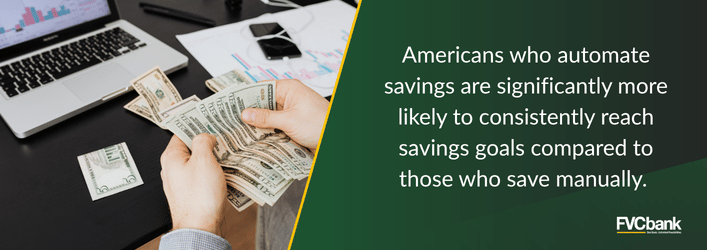
Even if you set a budget and do your best to stick with it, life can get in the way of meeting your goals. It can be easy to spend a little extra here and there, outside of your budget, and let your savings and debt reduction take a backseat for a while. Many of our customers find that setting up automatic savings makes it much easier for them to stick to their budget and meet their goals.
They do this by having their income deposited into a checking account, with automatic transfers into one or more savings accounts. You have this up to happen with each pay period, once a week, or once a month. With this approach, you only use your checking account for paying your bills, everyday spending, or withdrawing cash. If you’re not sure if this is the right approach, try starting with very small automatic transfers then increase the amount over time. If you can resist the urge to dip into your savings account, this can be a great way to keep your savings goals on track.
3. Build an Emergency Fund Gradually
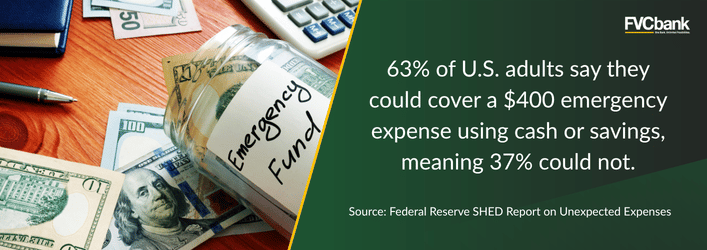
Financial advisors recommend that every household have an emergency fund that would cover at least two to three months’ worth of their household living expenses, which they could access at any time by keeping it in a savings account where they can also earn interest. This would give you a financial cushion to help protect you against a loss of income or an emergency expense.
A Federal Reserve survey last year indicated that 63% of American adults said they could cover an unexpected $400 expense by tapping into their cash, savings, or using a credit card that they would pay off in full at the end of the month. For those who couldn’t cover an unexpected expense, 24% said they would use some other method. Most of them said they would use a credit card but would be unable to pay off the balance when the bill comes due. The remaining 13% of respondents said they would not be able to cover that $400 expense.
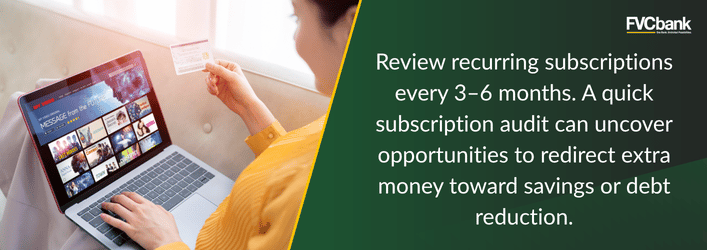
If you don’t have an emergency fund, or if you need to give yours a boost, try starting small. Take a close look at your nonessential spending and see what you could cut back on for a while or eliminate. Do you have any subscriptions, such as streaming services, that you could put on hold or eliminate? You might try having just one streaming service at a time to save money. Brewing your own coffee at home and bringing a thermos to work might not seem like you’re saving very much, but if you’re doing that five days a week and can add up to a considerable amount over time. The same goes for cooking your own meals at home rather than take-out, delivery, and restaurant meals.
4. Simplify your Finances with Bundled Banking
We know that banking and budgeting can seem complicated sometimes, so that’s why LifeBundled by FVCbank offers personal banking services and digital tools (such as an online bill pay) to make things as simple as possible. These bundled bank accounts deliver the convenience of all-in-one banking, with fewer fees and personal support from our banking team at eight branch locations.
Each package includes the FVCbank Mobile App with Zelle® plus online and mobile banking with bill pay, and we offer four LifeBundled packages to fit your situation:
- Start LifeBundled is for students and young professionals who are just getting started on their financial journey. It offers student checking and student savings accounts with no monthly maintenance fees.
- Grow LifeBundled is for individuals and families looking to expand their financial portfolios and invest for the future. This includes a Free Personalor Interest Checking Account, plus a First Statement Savings or Money Market Account.
- Secure LifeBundled is designed for savers, pre-retirees, and those focused on long-term financial security. This includes our Interest Checking Account plus Certificates of Deposit (CDs) or CDARS, retirement planning, and personal insurance products.
- Thrive LifeBundle is great for small business owners and entrepreneurs who need to manage their business and personal finances. It includes personal and business checking accounts, plus a money market account. We also offer a Business Credit Card and commercial lending (with credit approval).
5. Use Digital Banking to Stay in Control
With our online banking platform and mobile banking app, you can manage your funds, pay your bills, and keep track of your savings from just about anywhere. You can set up account alerts and make mobile deposits without having to visit a bank branch or an ATM. This not only saves time and makes banking more convenient, it also helps you keep track of your expenses and manage your budget.
6. Automate your Bill Payments
What better way to manage your finances than by setting up automatic bill payments for your regular expenses? Instead of cutting checks for your utility bills and other recurring expenses, keeping track of which bills you’ve paid, having them paid automatically from your checking account saves time and money and can help you maintain a good credit history. Just make sure that you’ll have enough funds in your account when each bill comes due.

7. Regularly Review Your Accounts
Even if you’ve automated your savings and bill payments, you’ll still need to review your accounts regularly—just like your budget. Most people do this at least once a month. You might discover that you’re saving more than you expected and can transfer more funds from your checking account to a savings account.
If your savings account has enough of an emergency fund built up, any excess savings could be put to use in other ways, such as opening a money market account or a certificate of deposit (CD) to earn more interest. You might also consider what’s known as a CD ladder, where you keep some of your savings and CDs of different term lengths. The idea here is that one of your CDs would mature every few months, so if an emergency came up, you could use the funds in your savings account and then tap into the next CD that comes to term. By reviewing your accounts on a regular basis you can find ways of improving your finances and maximizing your savings.
8. Set Short, Midterm-and Long-Term Financial Goals
Your financial goals should be SMART, which stands for Specific, Measurable, Achievable, Relevant, and Time-bound. Instead of just saying you’d like to reduce your debts, cut back on spending, and save more, try to be as specific as possible. Depending on where you are in life, your goals might be saving up for a major purchase (such as buying a home), building an emergency fund, or setting up an education fund. By giving yourself an amount and a timeline, and checking your progress on a regular basis, you’ll be more likely to meet your goals.
Your short-term goals are things you’d like to accomplish between six months and two years. For example, you might want to set up an emergency fund or improve the one you have. Maybe you have a debt that you could eliminate within the next year or so. Midterm goals range from two years to five years and might include saving up for a major purchase, such as a down payment on a home or a new vehicle. Long-term goals would be for something that’s more than five years away, such as setting a certain amount aside for a college fund or retirement.
9. Protect Your Finances
Setting up account alerts can be a great way to protect your finances. Many of our customers set up alerts for payments or withdrawals above a certain dollar amount from any of their accounts. You should also make sure that all of your passwords are as secure as possible and consider setting up multifactor authentication on your devices. This way, even if someone hacked your password they wouldn’t be able to access your email, your bank portal, and other accounts unless you approved it through a text message or a security app.
10. Build a Relationship with Your Bank
One of the many benefits of being a locally run bank is that we take a personal approach to dealing with our customers. With us, you’re more than an account number. If you need to apply for a business loan, a mortgage, or some other type of financing, you won’t have to wait for approval from someone in a faraway office somewhere. We make all our decisions locally, from people who understand and live in your community.
How Small Habits Build Confidence and a More Prosperous Future
It takes time to establish positive spending and saving habits, but it’s worth the effort. As you review your budget and goals from time to time, celebrate each accomplishment as getting you one step closer to success. Our LifeBundled accounts and digital banking tools are the kind of Maryland and Virginia banking solutions that can help you meet your goals. For more information on banking in the DC Metro area, contact one of our representatives by calling 703.436.3800. You can also contact us online or visit one of our locations in Fairfax County, Loudoun County, Arlington County, Virginia, and Washington, DC.